Concorso internazionale RIBA “The Wall. A Million Bricks” – fase 1, progetto vincitore
Anno: 2016
♦ Progetto vincitore
Un'architettura sull'acqua, tra astrazione e sacralità / An architecture on water, between abstraction and sacredness
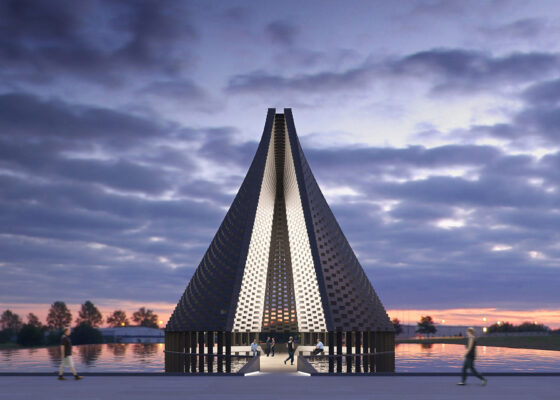
Il progetto nasce nell’ambito del concorso internazionale di progettazione promosso dal Royal Institute of British Architects (RIBA) per “The Wall. A Million Bricks”, un grande segno architettonico composto da un milione di mattoni, ognuno a rappresentare una preghiera esaudita. La proposta immagina The Wall come un’architettura sospesa sopra uno specchio d’acqua: l’acqua diventa un luogo sacro e inviolabile, una soglia tra il mondo terreno e una dimensione più astratta. Il muro, riflesso nel bacino, sembra perdere peso e radicamento, collocandosi in una dimensione quasi fuori dal tempo. L’insieme è volutamente essenziale: pochi segni, pochi materiali, un forte rapporto con l’orizzonte e con la luce naturale.
The project was developed for the international design competition promoted by the Royal Institute of British Architects (RIBA) for “The Wall. A Million Bricks”, a large architectural sign made of one million bricks, each representing an answered prayer. The proposal imagines The Wall as an architecture suspended above a reflecting pool: water becomes a sacred and untouchable place, a threshold between the physical world and a more abstract dimension. Reflected in the basin, the wall seems to lose weight and grounding, as if placed in a timeless condition. The overall language is deliberately essential: few signs, few materials, a strong relationship with the horizon and natural light.
Il peso della speranza / The weight of hope
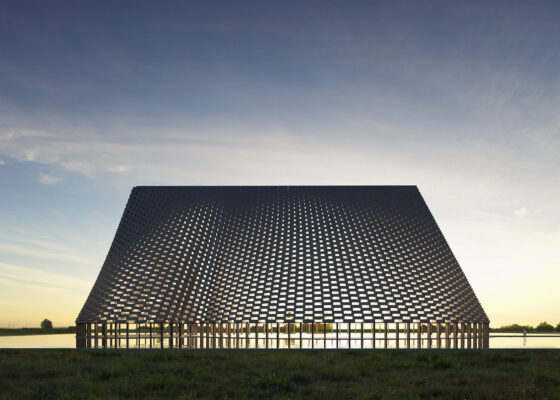
L’idea centrale del progetto è che The Wall sia, allo stesso tempo, pesante e leggero. Pesante come l’insieme delle speranze, delle paure e delle attese che le persone affidano alla preghiera; leggero perché queste stesse preghiere, una volta pronunciate, sembrano staccarsi dal peso del corpo e restare sospese in un’altra dimensione. L’architettura cerca di tradurre questa ambivalenza: il muro è un volume compatto, formato da un numero enorme di mattoni, ma appare sollevato, staccato dal suolo, come se fosse sostenuto da qualcosa che non vediamo. Lo specchio d’acqua contribuisce a questa percezione, riflettendo il volume e rendendo meno evidente il suo radicamento fisico.
The core idea of the project is that The Wall is both heavy and light at the same time. It is heavy, as it embodies the collective weight of hopes, fears and expectations entrusted to prayer; and yet it is light, because these same prayers, once spoken, seem to detach themselves from the body and remain suspended in another dimension. The architecture translates this duality: the wall is a compact volume composed of an enormous number of bricks, but it appears lifted off the ground, as if supported by something invisible. The reflecting pool reinforces this perception, duplicating the volume and softening the sense of its physical anchoring.
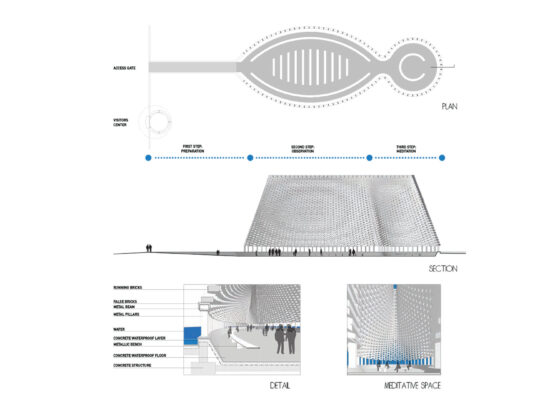
Il percorso del visitatore dall’ingresso all’area interna più sacra è un viaggio sempre più profondo dentro LA fede
The visitor’s path from the entrance to the most sacred inner area is a journey deeper and deeper into faith.
Un simbolo della fede, fragile e immateriale / A fragile and immaterial symbol of faith
Pur essendo costruito con un materiale resistente e tradizionale come il mattone, The Wall è pensato come un simbolo fragile e in parte immateriale. Non ha fondamenta visibili, presenta fori e cavità che ne alleggeriscono la massa e permettono alla luce di attraversarlo. In questo modo il muro non è un ostacolo compatto, ma una presenza porosa, attraversabile dallo sguardo e dalla luce, sospesa tra il cielo e l’acqua. La solidità del materiale contrasta con la leggerezza della sua configurazione: il risultato è un’architettura che rimanda alla forza della fede senza mai diventare monumentale in senso retorico.
Although it uses a solid and traditional material such as brick, The Wall is conceived as a fragile and partly immaterial symbol. It has no visible foundations and is punctuated by voids and cavities that lighten its mass and allow light to pass through. In this way, the wall is not a solid obstacle but a porous presence that can be visually crossed, hanging between sky and water. The material solidity of brick contrasts with the lightness of its configuration: the result is an architecture that alludes to the strength of faith without turning into a rhetorical monument.
Un tempio universale per la pace e l'unione tra i popoli / A universal temple for peace and unity among people
Uno degli obiettivi del progetto è creare un luogo aperto a tutte le religioni, evitando simbolismi eccessivamente connotati. L’architettura adotta un linguaggio neutrale, in cui alcuni riferimenti al mondo cristiano convivono con suggestioni provenienti dall’architettura buddista e islamica, senza che nessuna di queste tradizioni risulti predominante. La pianta è pensata come un grande abbraccio, una forma che avvolge lo spazio interno e suggerisce un’idea di accoglienza piuttosto che di separazione. In questo senso The Wall non è un muro che divide, ma un segno che raccoglie e unisce, un dispositivo spaziale che invita alla contemplazione e al raccoglimento, indipendentemente dal credo di ciascuno.
One of the main goals of the project is to create a place open to all religions, avoiding excessively connoted symbols. The architecture uses a neutral language, where some references to the Christian world coexist with suggestions from Buddhist and Islamic architecture, without any of these traditions becoming dominant. The plan is conceived as a large embrace, a form that wraps around the inner space and suggests an idea of welcome rather than separation. In this sense, The Wall is not a barrier that divides but a sign that gathers and unites, a spatial device inviting contemplation and reflection regardless of individual faith.
Il percorso del visitatore come un viaggio verso il centro / The visitor’s path as a journey towards the centre
Il cammino del visitatore, dall’ingresso all’area più interna, è concepito come un percorso graduale verso una dimensione di maggiore raccoglimento. Dal paesaggio esterno si entra in uno spazio di soglia, a contatto con l’acqua e con il riflesso del muro, per poi avanzare lentamente verso la parte più riparata e silenziosa. Questo tragitto non è solo uno spostamento fisico, ma un piccolo viaggio interiore: l’architettura accompagna il visitatore in una sequenza di spazi via via più concentrati, in cui il rumore del mondo esterno si attenua e l’attenzione si sposta sulla luce, sull’acqua, sul ritmo dei mattoni e sui vuoti che li intervallano. Il cuore del progetto non è un singolo punto, ma l’esperienza stessa del percorso.
The visitor’s route, from the entrance to the innermost area, is conceived as a gradual movement towards a more intimate dimension. From the surrounding landscape one enters a threshold space, in contact with the water and with the reflection of the wall, then slowly progresses towards the most sheltered and silent part. This path is not only a physical movement but also a small inner journey: the architecture guides visitors through a sequence of increasingly focused spaces, where the noise of the outside world fades and attention shifts to light, water, the rhythm of bricks and the voids between them. The heart of the project is not a single point, but the experience of the journey itself.
Il progetto è stato sviluppato nell’ambito del concorso internazionale RIBA “The Wall. A Million Bricks”, promosso dall’ente Network – The Evangelical Council for the Manchester Area Trust, che prevedeva la selezione di un numero ristretto di proposte per una seconda fase a inviti.
The project was developed for the international RIBA competition “The Wall. A Million Bricks”, promoted by Network – The Evangelical Council for the Manchester Area Trust, which foresaw a restricted shortlist of proposals for a second invited stage.